

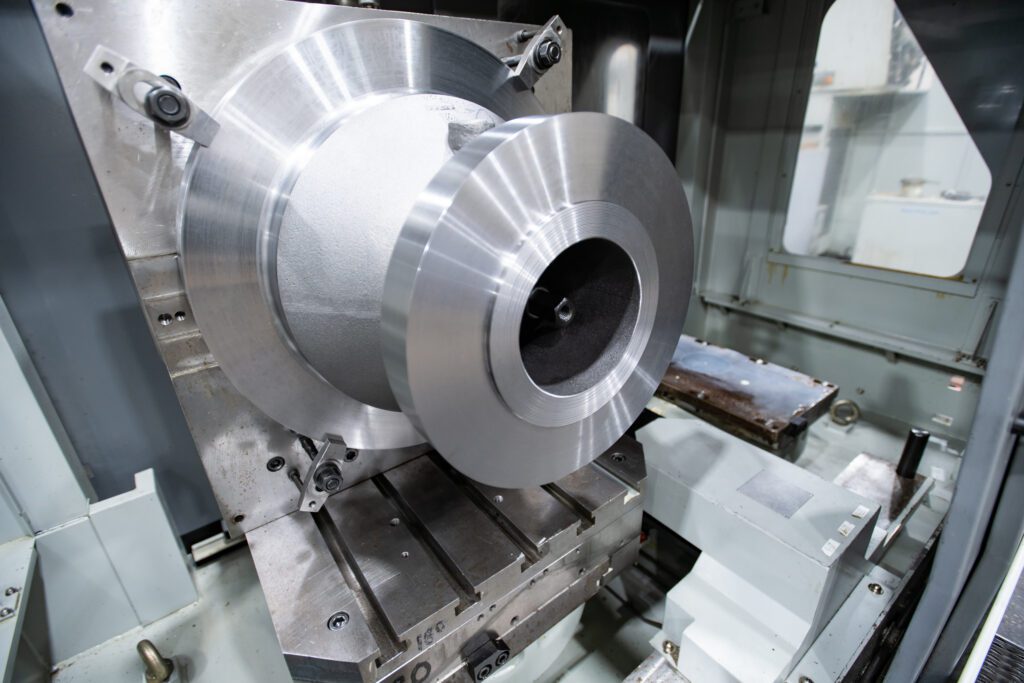
The final step in the manufacturing of a casting is machining it to its final dimensions, tolerances, and desired surface finish. While a foundry can create complex shapes through the casting process, machining is typically required to achieve very tight tolerances, precision fits, smooth sealing surfaces, and other performance-critical specifications. Machining adds the precision needed for assembly and performance.
First, a rough casting is prepared for machining by removing gates, runners and risers remaining from the casting process. This includes grinding away excess metal (flash), shot/sand blasting it to remove mold sand and scale, and inspecting it for defects such as porosity, cracks, or shrinkage.
If required, the casting is then heat treated to relieve internal stresses, improve hardness or strength, and stabilize the casting’s dimensions.
Next, the casting is checked against engineering drawings to identify critical surfaces, establish reference points, and verify dimensions.
Then, the casting is “rough machined” to remove excess material from areas that require precise dimensions while maintaining the part’s integrity and stability. This includes:
Semi-finish machining is an intermediate step that helps prepare a casting for finish machining. This step is necessary when tight tolerances are required, large amounts of material must be removed, the part may distort (e.g. large castings and/or thin-walled parts), surface finish requirements are high, etc.
Semi finishing can be skipped when tolerances are relatively loose, the part is small and rigid, a small amount of stock must be removed, and/or production cost is more important than precision.
Finish machining is the final cutting operation. This step ensures the casting’s final dimensions and surface finish are achieved. This includes tight dimensional tolerance, precise hole locations, bearing fits, sealing surfaces, and surface finish requirements.
After machining, rotating parts must be balanced to ensure their mass is distributed evenly around the axis of rotation. If a rotating component is unbalanced, it can cause vibration, premature bearing wear, poor performance, and safety issues. Balancing is achieved by measuring and locating any imbalance and correcting it by removing or adding material and/or adjusting balance weights.
Many rotating parts — like gears, couplings, and impellers — also require a positive mechanical connection between a shaft and a mounted component. This can be achieved through keyway cutting. A keyway is a precisely machined groove that matches a metal key, which can be inserted to mechanically lock two parts together so torque can be transmitted without slipping.
If assembly is required, the finished casting is then combined with other components to create a functional assembly or complete product. This can include installing bearings, bushings, shafts, gears, seals, fasteners, etc. Not all foundries perform assembly; some ship the machined casting to the customer for assembly.
If you seek to improve the quality of your castings and lower the cost of quality, you’re your machining performed by your castings manufacturer. When a castings supplier is asked to deliver un-machined castings, they are prevented from identifying and resolving issues that can only be discovered during the machining process. Castings suppliers that are responsible for the machined castings have the knowledge, incentive and tools necessary to provide the most efficient solution.
Badger Alloys can move a casting from the design stage all the way through assembly on our manufacturing campus in Milwaukee, WI. This full-service capability not only saves our customers time and money; it reduces errors and the possibility of damage in transit between multiple facilities.
Our dedicated Machine Shop features top-notch equipment and the unique ability to:
We continuously invest in the latest machining equipment, and our certified machinists have decades of experience in meeting tight tolerances and performance specifications. For more information on our machining services and equipment, visit badgeralloys.com or call Nick Hanson at 414/258-8200.